
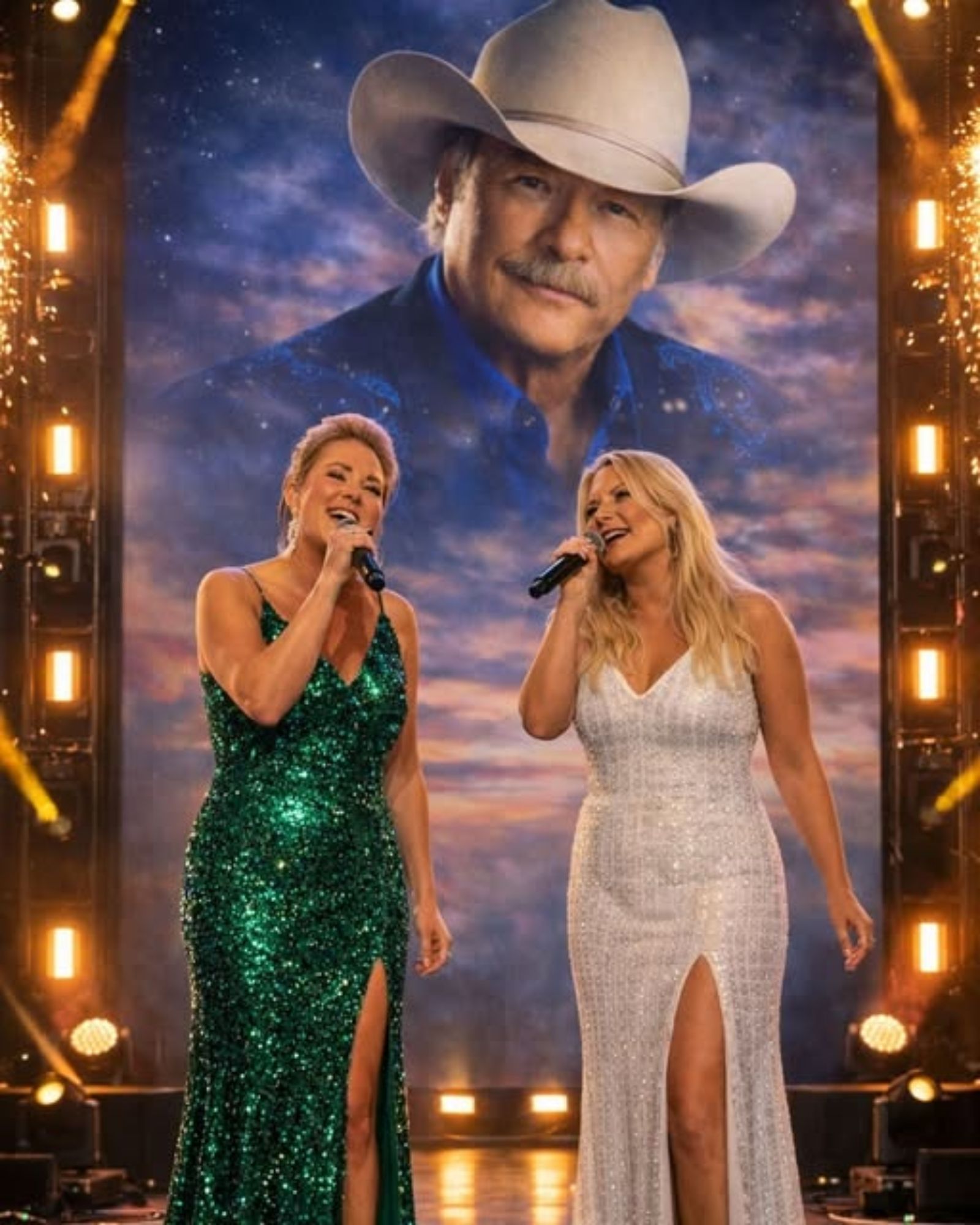
At the Nashville Center, the room didn't grow quiet because the music was soft. The room grew quiet because everyone was listening harder.
People had come expecting the usual rhythm of a night out—smiles, clapping, a little chatter between songs. The seats filled with familiar faces from Music City: friends, musicians, industry folks, fans who'd driven in because the name Alan Jackson still carries a certain weight. Not loud weight. The kind that settles. The kind that makes you remember where you were the first time you heard a line that felt like it was written for your life.
Then Mattie Jackson and Dani Jackson stepped onto the stage without announcement, without spectacle, and began singing Remember When.
No drum count. No big introduction. Just two voices meeting in the air like they'd done it a thousand times in a kitchen, long before a stage ever existed. Their voices were steady, careful, almost restrained—like they knew the song didn't belong to them alone. They sang it like someone carrying a glass of water across a room full of people. Slow. Respectful. Determined not to spill what matters.
THE SONG THAT DOESN'T NEED ANYTHING ADDED
Remember When is one of those songs that doesn't ask to be improved. It isn't built for vocal fireworks. It's built for time. It's built for the way life changes without asking permission—how the years pile up, how love grows quieter, how you blink and suddenly the "then" in the lyric becomes the "now" in your chest.
Mattie Jackson and Dani Jackson didn't try to turn the song into a new statement. They didn't dress it up or chase a modern edge. They gave it space. They let the pauses sit where they're supposed to sit. They let the simple lines land without pushing them. In a world that's constantly shouting for attention, that restraint felt like courage.
And in the front row, Alan Jackson didn't sing a word. Alan Jackson sat still, hands folded, listening to his own memories returned to him through the people who came from them.
ALAN JACKSON IN THE FRONT ROW
It's one thing to hear a song you wrote being covered by a stranger. That can be flattering, even thrilling. It's another thing entirely to hear it sung by your daughters—by Mattie Jackson and Dani Jackson—whose lives are stitched into the same story the song is trying to tell.
People in the audience kept stealing glances toward Alan Jackson. Not in a rude way. In a human way. Like everyone understood they were watching something that rarely happens in public. Alan Jackson wasn't there as a headline or a trophy. Alan Jackson was there as a father, being handed a mirror that reflects decades.
There's a particular kind of silence that happens when a crowd stops acting like a crowd. It's the silence of people deciding, together, not to interrupt something sacred. A few phones were raised, but even those hands seemed unsure—like filming would be too loud. Like capturing it might flatten it. Like the moment deserved to stay alive, not stored.
NOT A TRIBUTE BUILT FOR HEADLINES
There was no performance energy, no attempt to impress. No big "look at us" move. Mattie Jackson and Dani Jackson weren't trying to steal a spotlight. They were doing something quieter and harder: they were continuing a story that already had gravity.
From the stage, you could feel it—the sense that this wasn't an event designed by publicists. This was a family moment that happened to be witnessed. The kind of moment that doesn't need an encore because it isn't entertainment. It's recognition.
Some songs grow older with us. Others wait quietly until the right voices arrive to continue the story.
THE PAUSES THAT FELT HEAVIER THAN APPLAUSE
As the song moved forward, those familiar lines didn't sound like nostalgia. They sounded like proof. Proof that the life described in the song wasn't just poetic imagination. Proof that love really does change shape and still remain love. Proof that a man can build a legacy not only through records, but through the people who learned to breathe to the same rhythm.
Near the end, the room felt suspended. Even the air-conditioning seemed quieter. And when the final note faded, something strange happened: the audience hesitated.
It wasn't because people didn't appreciate it. It was because people didn't know if clapping would break the spell. The applause did come—soft at first, then rising—but it came with the careful tone of people closing a door gently.
Some moments don't ask for noise. Some moments ask for respect.
WHAT WOULD YOU DO?
Maybe that's the real heart of the night at the Nashville Center: it reminded everyone that music isn't always a show. Sometimes music is a family language. Sometimes a song becomes a bridge, and the people who walk across it aren't chasing attention—they're carrying history.
Mattie Jackson and Dani Jackson didn't just sing Remember When. Mattie Jackson and Dani Jackson returned it to its source, right there in front of Alan Jackson, and let the room witness what the song has always been about: a life that kept going, a love that kept staying, a story that didn't end when the record stopped.
If you were sitting there, would you clap—or would you stay silent and let the moment finish on its own?